这是台湾清华赵启超教授离散数学9C9D课程的笔记。
Enumeration 9A
Unordered Selections with Repetition
The number of unordered selections, without repetitions, of m things from a set of size n is
m!n(n−1)…(n−m+1)=△(nm)(binomial coefficient)
Example 1
Let A be a set with ∣A∣=8
- How many three-element subsets(3-subsets) does A have?
Answer:
(83)=3⋅2⋅18⋅7⋅6=56
- How many 5-subsets does ∣A∣ have?
Answer:
(85)
- How many 9-subsets does ∣A∣ have?
Answer: 上面比下面小的时候,直接就等于0。
(89)=0
Property
Pascal's Identity
(nr)=(n−1r−1)+(n−1r)
(nr) is the number of r-subsets of {1,2,3,…,b}
(n−1r−1) is the number of r-subsets with n
(n−1r) is the number of r-subsets without n
Pascal's Triangle
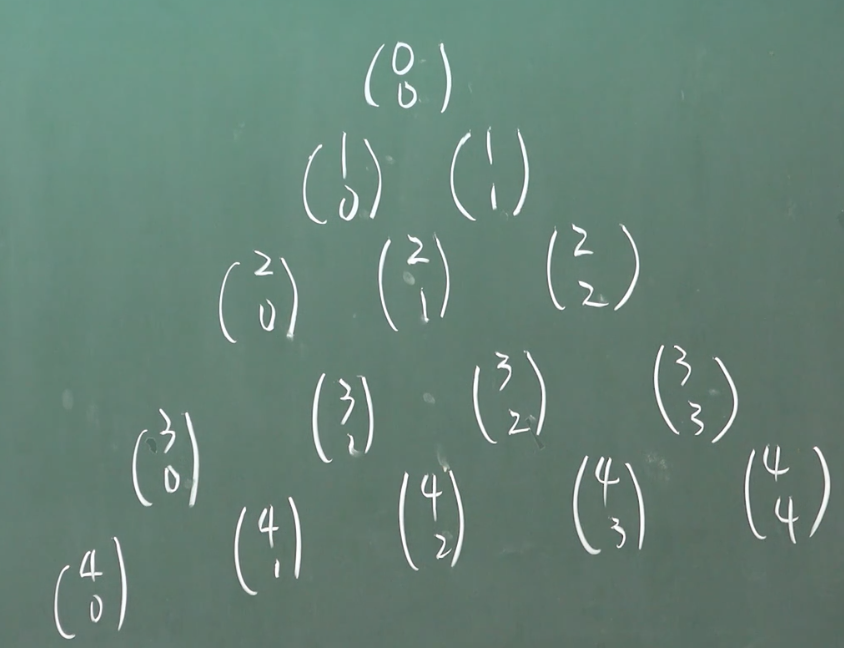
Clearly (nr)=(nn−r) for r≤n
Binomail Theorem
(x+y)n=r=0∑n=(nr)xn−ryr
Example 2
(n0)+(n1)+…+(nn)=2n
Proof:
(x+y)n=r=0∑n=(nr)xn−ryr
substituting x=y=1 to the above identity
2n=(1+1)n=r=0∑n(nr)
Example 3
(n0)2+(n1)2+…+(nn)2=(2nn)
Proof:
Note (1+x)n(1+x)n=(1+x)2n. On the left-hand side, the coefficient of xn in (1+x)n(1+x)n
(n0)(nn)+(n1)(nn−1)+(n2)(nn−2)+…+(nn)(n0)
since
(1+x)n=(n0)+(n1)x+…+(nr)xr+(nn)xn
Example 4
(n0)−(n1)+(n2)+…+(−1)n−1(nn−1)+(−1)n(nn)=0
Example 5
Note (x+y)n=∑r=0n(nr)xn−ryr
Let x=1 and y=−1 then we have
0=(1−1)n